
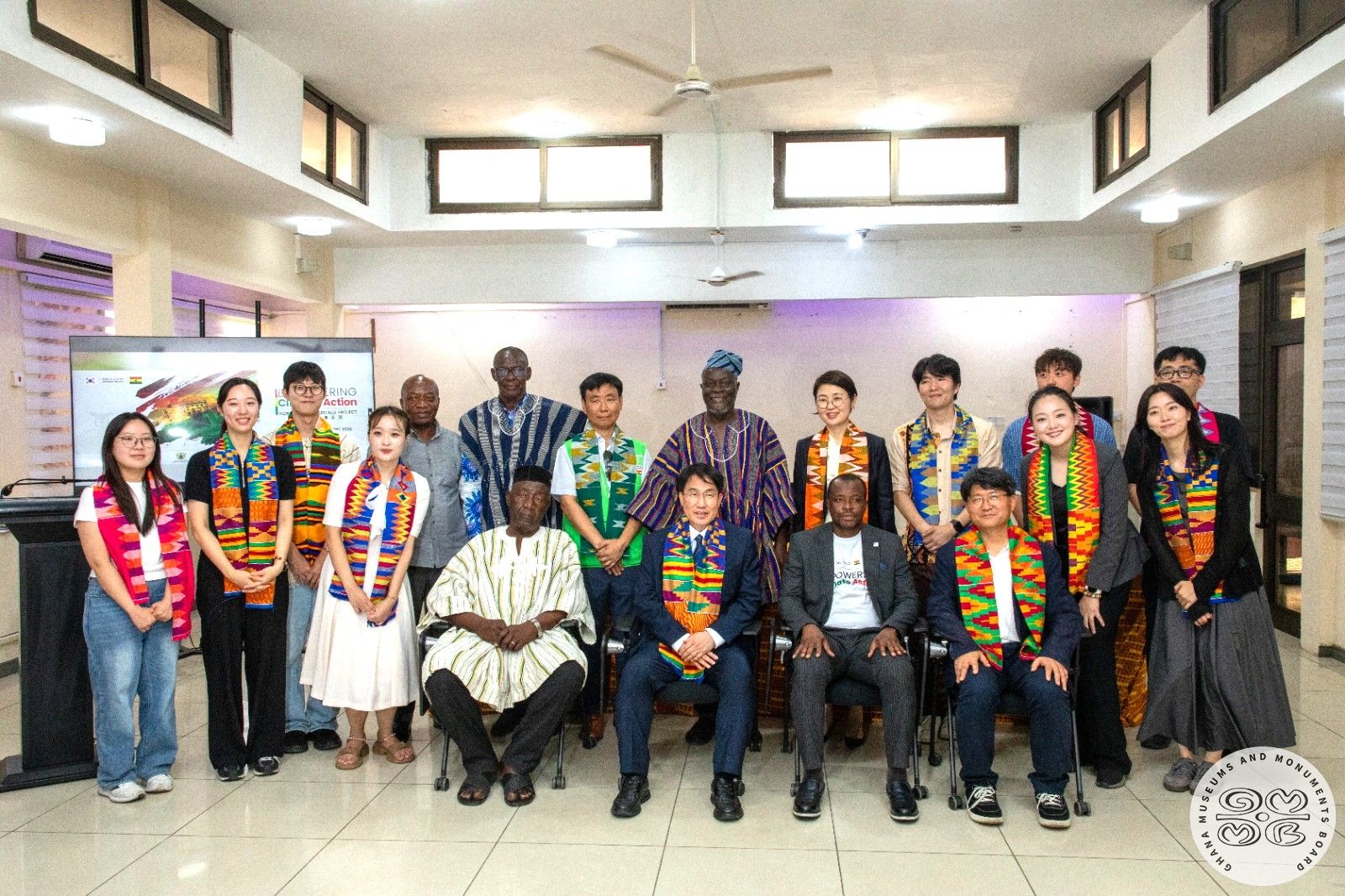
A Five-Year Partnership to Strengthen Climate Resilience for Ghana’s Heritage
The Republic of Ghana and the Republic of Korea have officially launched the Ghana-Korea Climate Change and Cultural Heritage Project, marking the beginning of a five-year programme that will run from 2026 to 2030 to strengthen Ghana’s capacity to understand, monitor and respond to the impacts of climate change on its cultural heritage.
The launch brings together a broad network of Ghanaian ministries, government agencies, heritage institutions, technical bodies, academic institutions and local stakeholders, working alongside Korean partners and international heritage organisations. GMMB is an important institutional partner within this wider national collaboration.
The launch follows a series of preparatory activities, including a symposium and intensive capacity-building sessions involving participants who received practical training in areas such as drone operations, field inspection, aerial documentation, damage assessment and climate-risk monitoring.
As part of the initial phase of the programme, equipment has also been provided to support the technical work required for climate-change assessment and monitoring of Ghana’s historic forts and castles.
However, the launch represents only the beginning of a much broader five-year journey.
Over the coming years, the project will progress through successive phases involving baseline surveys, climate-risk assessment, development of risk maps, monitoring and data collection, capacity building, joint research, community engagement, development of climate-change response plans and the establishment of a sustainable monitoring and management system.
By 2030, the programme is expected to contribute to the development of a national heritage climate-change response policy, climate-change response plans for Ghana’s forts and castles, a climate-risk map, West African climate-change guidelines and an integrated, science- and data-based approach to heritage management.
The project is therefore not simply about restoring individual monuments. Its broader ambition is to establish a proactive and preventive system through which climate risks can be identified, documented, monitored and addressed before they result in irreversible damage.
For Ghana, this collaboration represents an opportunity to strengthen national expertise, technological capacity, scientific research, institutional coordination and evidence-based decision-making in the protection of our cultural heritage.
The journey from 2026 to 2030 will involve research, training, fieldwork, technology, policy development, community participation and continuous learning.
The launch is only the beginning.
Together, Ghana and Korea are laying the foundation for a more resilient and sustainable approach to safeguarding Ghana’s heritage in a changing climate.