
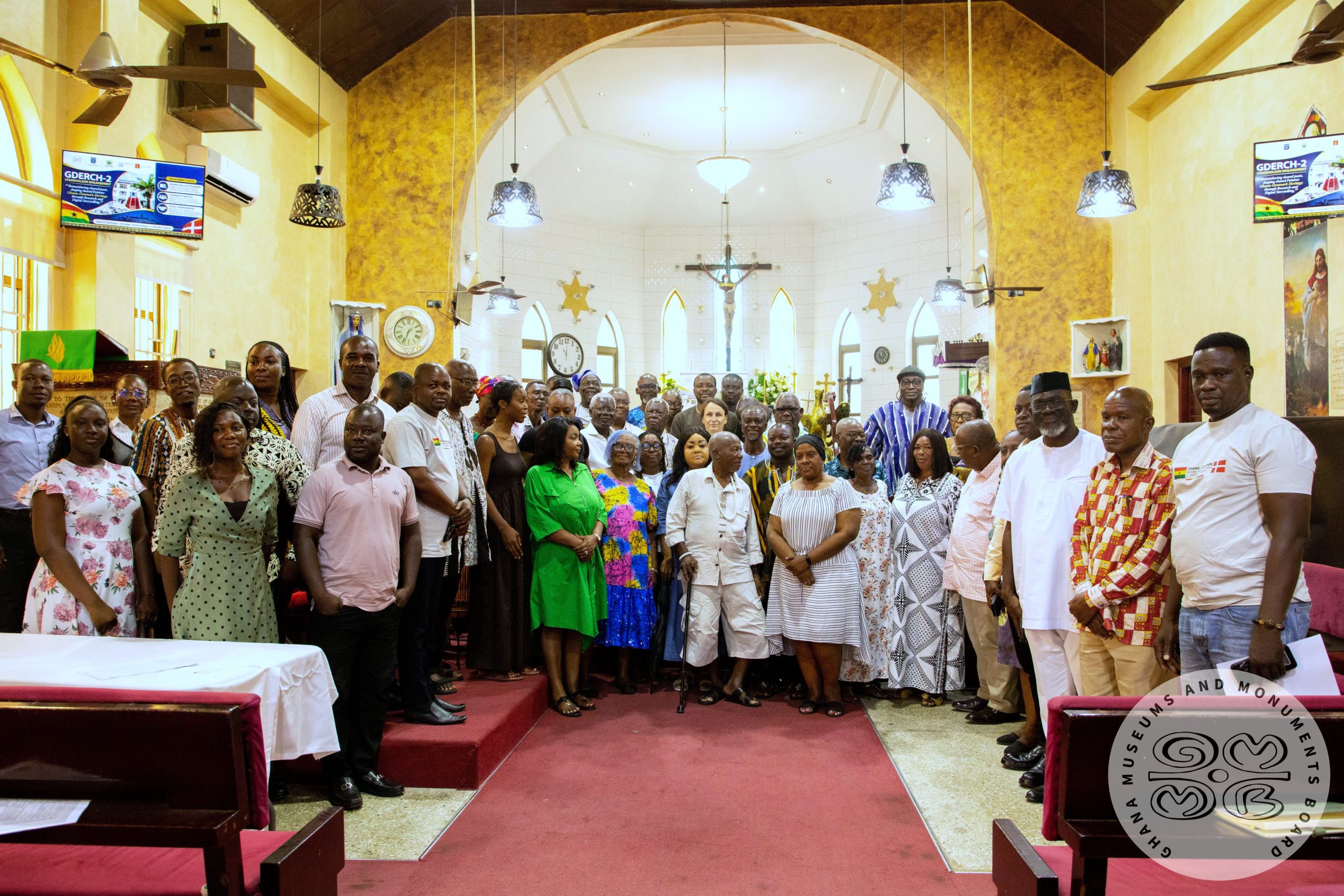
The Ghana Museums and Monuments Board (GMMB), in collaboration with the University of Ghana and Danish partners, has advanced efforts to strengthen the research, documentation, preservation and digital presentation of shared Ghanaian-Danish heritage through the Ghana-Denmark Cultural Heritage Initiative (GDERCH-2).
The initiative was marked by a two-day programme comprising a stakeholder engagement and the official launch of the project, bringing together representatives of government, academia, heritage institutions, traditional authorities, development partners and other stakeholders to explore opportunities for deeper collaboration in heritage research and digital storytelling.
The activities were held under the theme, “Remembering Shared Pasts, Shaping Shared Futures: Ghana-Denmark Heritage through Research and Digital Storytelling.”
Stakeholder Engagement: Building a Shared Understanding
The stakeholder engagement provided an opportunity for participants to discuss the historical connections between Ghana and Denmark and examine how research, institutional collaboration and digital technologies could contribute to the preservation and accessibility of their shared heritage.
Discussions focused on the importance of documenting historical resources, strengthening the management of heritage information and developing innovative ways to communicate historical narratives to wider audiences. Participants also considered the role of museums, universities, researchers, traditional authorities and local communities in ensuring that historical interpretations are accurate, inclusive and grounded in credible evidence.
The engagement highlighted the importance of bringing together historical records, archival materials, museum collections, archaeological evidence and community memories held in both countries. By connecting these resources, the initiative seeks to encourage a more comprehensive understanding of the historical relationships that have shaped Ghanaian and Danish societies.
Official Launch at Wulff House
The official launch of GDERCH-2 took place on Wednesday, 11 November 2026, at Wulff House, Accra.
The ceremony brought together representatives of the Ministry of Tourism, Culture and Creative Arts, the Embassy of Denmark in Ghana, the University of Ghana, the Ghana Museums and Monuments Board and other stakeholders in the heritage sector.
In their respective addresses, speakers highlighted the importance of examining shared historical experiences through research, collaboration, responsible heritage interpretation and the value of strengthening relationships between Ghanaian and Danish institutions to advance the preservation and communication of historical knowledge.
The official launch was jointly undertaken by the Deputy Minister of Tourism, Culture and Creative Arts, Hon. Yussif Issaka Jajah and the Ambassador of Denmark to Ghana, H.E. Jakob Linulf, marking the commencement of this important collaborative initiative.
Exploring Ghana and Denmark’s Shared Historical Connections
The historical relationship between Ghana and Denmark forms an important part of the history of the Gold Coast and its connections with Europe and the wider world.
Evidence of these connections can be found in historic forts and castles, archival records, archaeological materials and the memories of communities associated with these historical encounters. These resources provide important insights into trade, political and economic relations, cultural encounters and the movement of people and ideas.
They also preserve evidence of difficult historical experiences, particularly the transatlantic slave trade and European colonial activities along the Gold Coast. These histories require careful research, honest reflection and interpretation that recognises the experiences and perspectives of the communities concerned.
Through GDERCH-2, Ghanaian and Danish institutions have an opportunity to bring together different historical sources, research materials and perspectives to deepen understanding of this interconnected past.
The initiative recognises that shared heritage is not limited to physical monuments and museum objects. It also encompasses historical documents, oral histories, cultural memories and the experiences of people whose lives and communities were shaped by these connections.
Research and Digital Storytelling for Greater Accessibility
A key component of GDERCH-2 is the use of research and digital technologies to strengthen heritage documentation and make historical knowledge more accessible.
Digital documentation, online collections, audiovisual materials, interactive platforms and three-dimensional representations offer new opportunities to connect historical objects, sites, records and narratives.
These approaches can enable audiences in Ghana, Denmark and beyond to engage with historical resources that may be held in different museums, archives and institutions. They also create opportunities for researchers, students, educators and the general public to explore shared histories through accessible and engaging digital experiences.
For the Ghana Museums and Monuments Board, the initiative presents an opportunity to strengthen institutional approaches to collections documentation, heritage management, research and public engagement.
By combining academic research, professional heritage practice and digital innovation, the project seeks to encourage new ways of preserving and communicating the historical connections between the two countries.
Building Lasting Institutional and Cultural Partnerships
Beyond its immediate research and digital objectives, GDERCH-2 provides an important platform for strengthening cooperation between Ghanaian and Danish institutions.
The collaboration involving the University of Ghana, particularly the Department of Archaeology and Heritage Studies, the Ghana Museums and Monuments Board and Danish partners is expected to encourage knowledge exchange, professional development and further research into shared historical experiences.
The initiative also presents opportunities for educational engagement, cultural exchange and heritage tourism by creating new ways for people to explore the historical connections between Ghana and Denmark.
Importantly, the project’s long-term value will depend on the continued involvement of heritage institutions, researchers and communities in preserving, managing and communicating the knowledge and digital resources developed through the collaboration.
Shaping a Shared Future Through Heritage
The GDERCH-2 Initiative reinforces the importance of heritage as a foundation for historical understanding, cultural identity and international cooperation.
By examining interconnected histories, bringing together research and archival resources, and embracing digital storytelling, Ghana and Denmark are creating opportunities to deepen mutual understanding and ensure that their shared heritage remains accessible to future generations.
The Ghana Museums and Monuments Board recognises the importance of this partnership and remains committed to working with its collaborators to advance the documentation, preservation, interpretation and promotion of Ghana’s cultural heritage.
As the initiative progresses, its central aspiration remains clear: to transform shared historical knowledge into opportunities for learning, collaboration and a stronger cultural relationship between Ghana and Denmark.